Showing posts with label Arthur Johnson. Show all posts

Monday, November 29, 2021

 My Grandparents, Ida Nelson and Arthur Johnson, were married on November 30, 1918. The following was a speech, written and delivered for his parents, by their son and my uncle, Don Johnson, at the program of their 50th-anniversary open house celebration. It was held in November 1968 at the New Gottland Covenant Church near McPherson, Kansas.

November 1918

My Parents 50th Anniversary Speech
Arthur and Ida Johnson

By Donald J Johnson

 Arthur, probably realizing that the approaching winter would be hard and cold, decided that it would be nice to have a wife. They had met in Kansas City, Missouri, but Dad was now back on the farm in Kansas. He left Galva by train on November 28, 1918, and headed for Osage City, Kansas, where Mother’s family resided. After a day or two of deliberation, Ida was convinced that they should get married in Topeka, Kansas. They made that journey to Topeka and were married on November 30, 1918.

1958 On their farm near New Gottland

 Following the wedding, they continued on to Kansas City, Missouri, for the night, and then on to Excelsior Springs, Missouri for a few days, where Ida toured the city, and Arthur remained in their room recuperating from the flu. The happy newlyweds returned to Galva as the blizzard of 1918 was raging, and they continued their honeymoon at the Galva Hotel.

 Their carriage chauffeured by Arthur’s brother Reuben, and his cousin Joe Johnson, got lost in the blizzard. A few days later, Teddy Nordstrom, a friend of Dad’s, arrived by team and wagon to escort them to their new home. 

1968
 
Six children were born to this union: Helen Margaret, Earl, Donald, and Helen Lucille were the children of their first family, and LaDonna and LeRay were children of their ‘second family.’ LaDonna and LeRay were so much younger that the folks felt as if they had two families. 

 This is the Thanksgiving season, and we would like to thank the folks and God for the privilege of being raised in a home where much love was shown. Even though we realize that the times must have been difficult, and money was frequently a problem, they provided us with interesting and memorable experiences.

1978
 Journeys to visit grandparents, aunts, uncles, and cousins at Osage City and Kansas City, in our Model T Ford touring car were always looked forward to and enjoyed. The trip to the Rio Grande Valley to visit grandparents. To Padre Island where the pigs ate our dinner, and on to the gulf of Old Mexico, where I fell out of that old Ford into a mud puddle will always be remembered. 

 Thank you, Mom and Dad, for the discipline that was given to us while we were kids, and I was probably the hardest one to handle. I believe that I know more about discipline than the others, as I seemed to get in the most trouble. They taught us to know right from wrong by various methods, such as Dad wielding the razor strap, or mother washing our mouths out with soap and water, or maybe spending the evening in a dark room.

 
1985
We also learned that we had better tell the truth or else suffer the consequences. That learning must have prompted me to report to Dad, and he nearly fell from the seat of his horse-drawn mower with laughter when I told him that I threw the hairbrush at Earl and broke the cupboard window, but it really wasn’t my fault because Earl ducked. 

 Earl never got in trouble that I remember. I guess he never did anything wrong, or else he was more able to avoid detection after he committed a misdeed.

 LaDonna and LeRay were brought up differently. They could do things that were worse than anything that we older ones ever thought of doing, and they didn’t have to suffer the consequences than we did.


Happy Anniversary!


Arthur, Ida, Helen, Earl, Don,
LeRay, and LaDonna
About 1940


Sunday, November 21, 2021

100 Years

My dad, Earl Milan Johnson, was born on October 23, 1921. For his hundredth year, I'm publishing some writing of his that I found a few years after he died. Here is the next installment.

 Trips and Vacations

by Earl Johnson

One of my earliest recollections was a trip our family took to the Rio Grande Valley in Texas when I was about 5 years old to visit our grandparents. We made the trip in a 1921 Model T Ford, and it took us almost a week to get there. I can remember driving across the state of Oklahoma on 81 Highway. 81 was not paved at the time. It had been raining and we drove in a rut for a good distance. An air-cooled Franklin was in the rut ahead of us and rolled over, possibly because the different wheelbase did not fit the rut. I remember how proud we (Don and I) were of the old Model T which made it through without tipping over.

Don, Helen, Ida, and Earl on Padre Island
Before leaving on the trip, we went to Wichita in our 1917 Model T with the intention of trading for a better car. I remember looking at an old Dodge with an enclosed cab and disc wheels. We liked it but because of the enclosed cab and disc wheels (carbon monoxide dangers and difficulty installing chains), Dad elected to buy the 1921 Model T touring car.

We spent almost 3 months in the valley with our grandparents that year (approx. 1925-1926) It was a different
life for us with palm trees and citrus orchards, meeting people from Mexico, and seeing the Gulf of Mexico.

I remember one side trip to the Gulf of Mexico where we, including the car, went to an island for a
picnic. After getting to the island, we left the car and took a long walk along the beach. While we were gone, some pigs got into the car and into the picnic lunch, so we had nothing to eat while on the island.

I also remember trips across the border into old Mexico since we at Alamo and McAllen were only about 7 miles from the border.

The Texas trip was the only long trip I can remember during our growing-up years.

We did go to Osage City, Kansas about 130 miles once or twice each year to visit Grandpa and Grandma Nelson, and Mother’s brother Emil and family. Then perhaps 2 or 3 trips to Kansas City, Missouri to visit Mother’s sisters and their families and other relatives.

Family Group at Johnson/Nordling Reunion
Wamego, Kansas 1937
Also, for several years, we went to Wamego, Kansas for the Johnson – Nordling reunion (halfway between K. C. and McPherson). This was Dad’s family. (About 129 miles)

We also went to Wichita perhaps twice per year to visit Edwin Johnson’s. Mrs. Johnson, “Melia”, was Mother’s 1st cousin. They had 1 son, Wilbur, about our age. The Johnsons were prosperous and owned the Johnson Bros Auto Supply along with two other brothers. Wilbur had lots of toys and often, when they came to visit us in McPherson County in their big Packard, they would bring us toys if Wilbur was tired of them. Years later I worked for Johnson Bros for a few months while in training for aircraft work in Wichita. Theirs was a wholesale and retail business. They even dealt in La France fire engines for a time.


Tuesday, November 16, 2021

100 Years

 My dad, Earl Milan Johnson, was born on October 23, 1921. For his hundredth year, I'm publishing some writing of his that I found a few years after he died. Here is the first installment.

Oil and Gas

By Earl Johnson

Another early recollection was oil wells and gas wells and especially the drilling of the wells.

Dad, Don, and I would go to a drill rig almost every evening and sit and watch the drilling operation. We heard many tales from the driller and tool dressers and made many acquaintances including a driller by the name of Herb Long. He would become a partner in a wildcat drilling operation later with Dad and Grandfather, John A. Johnson.

As boys, Don and I had our own play drill rigs with which we drilled our own wells using the pully, rope, and bit method. I remember standing outside North Union School and seeing the Chinburg well blow in, spewing oil and water into the air high above the derrick.

There was a booster station right next to North Union School which was used to pump crude oil to the refineries.

There were two refineries in McPherson, the Globe Refinery which later became the Coop refinery and is still in existence as the CHS Refinery, and another whose name I can’t remember.

Don and Earl with their mother, Ida Johnson.
1937

I remember one incident of an explosion where two oil company workers were killed. They were laid on an A-frame truck, and were brought out past North Union School, a sight that several of us remember. There were no ambulances in those days.

There was an influx of oil company workers into the community at that time. They lived in temporary shacks, or tents, or in their cars. I remember a shack and tent village that was set up in the Roseburg timber. The Skates family, the Reynolds, the Hallenbacks, the Brinkmans, the Boyds, the Byerlys, the Donhains, the Birges, and other oil company families became important citizens of the community.

Alfred Hallenback was in my class and was later killed in an oil field accident. We were up to 44 kids one year at North Union School, all 8 grades and one teacher.

The Reynolds family lived just across the road from our house. They had 8 daughters. I remember Juanita and Rose Marie as being two of them. They were wonderful neighbors. Bill pumped and maintained several of the wells in the area and was a wonderful help to Dad.

The Johnson estate, the 3 eighties of flat land, had several oil wells and at least 2 gas wells. One of the gas-producing wells enabled our grandparents to retire when Grandpa was about 60. They spent their winters in Texas and summers in Kansas for many years. They had purchased an eighty of unbroken land in Texas around World War I.

The wells were nearly all Kansas City line formation wells and drilled to approximately 2300 feet. A few were drilled deeper to other formations but produced a lower grade of crude oil. At that time, they drilled 4 wells to 40 acres, evenly spacing helped. Most oil wells produced some gas, and this produced fuel for the gas engines used in pumping the wells. Access roads to the wells were arranged in north-south or east-west directions and were another hindrance to farming. Also, one engine often pumped 2 wells with a pump rod in between.

Many farmers were able to bring the gas from the wells to their homes and had free heating fuel and gas-lighting.

There was lots of “wildcatting” and many “dry holes.” A typical setup would be a road to the site, a slush pond to handle sludge from the drilling operation, a wood derrick possibly fifty-foot tall to handle the cable, bits, and bailers, and install casing in the wells, an engine house for gas or oil field engines, and a beltway or rod way house between the engine room and the drilling rig to operate the tools.


Drilling is really a misnomer as the early rigs used the drop bit method to produce the hole. They were called cable tools.

Dad, Herb Long, and Grandpa Johnson owned a cable rig and drilled two wells, one near Bushton, Kansas and one near Hoisington. The Bushton site produced a good well, as much as 800 barrels per day if allowed to produce at full capacity. In order not to have an oil surplus, wells were prorated down, big wells sometimes to 1/10 of full production. The Hoisington well appeared to be an even better prospect, maybe up to a 1000 barrels per day, but after developing, acidizing salt water came in and ruined the well. That ended the oil business for Dad and Grandpa. They lost the Bushton lease, the cable rig, and it left them with almost thirty thousand dollars in debt. Dad assumed responsibility for this and offered to give up his share of the land inheritance. His brothers and sisters did not accept this and later made him an equal heir. Needless to say, it caused our family some difficult years along with the depression and drought years of the thirties. Grandpa was financially able to shrug it off because of income from wells on his land.


Friday, November 12, 2021

100 Years

My dad, Earl Milan Johnson, was born on October 23, 1921. For his hundredth year, I'm publishing some writing of his that I found a few years after he died. Here is the second  installment.

Grade School Education  

by Earl Johnson
(written sometime in the 1990s) 

 I started grade school in September of 1926 at North Union School which was about ¾ miles east, one mile south, and a quarter-mile east of the Gustafson place where we lived. Dad and his brothers and sisters, also my brothers and sisters all attended grade


school at that location in a small building which was replaced by a larger approximately 40x40 foot building. The building had only 1 classroom, a library, boys and girls cloakrooms and a full basement. Toilet facilities were outside. 

 My first years in school were very difficult for me because I was a lefthander.  Educators at that time believed that being left-handed was a disability and thought to change it. Viola Engstrom was my teacher and used to whack my left hand with a ruler each time she caught me using it. This caused me not only pain but also fear and most likely set me back in the learning process. I would claim illness and play hookey. I should add at this time that Ms. Engstrom was a lovely and beautiful young woman and was only carrying out her job as a teacher.  She was a local girl and grew up on the next quarter east of the school.
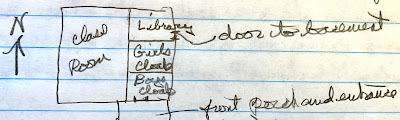

This building was later made into a home and still stands in good condition.


I do feel that it slowed my learning ability and concentration at least during the first few years and hurt my ability to throw a ball, etc. I was able to use either hand for most things except writing which helped me in other ways.  

 Robert Benson, Rachel Clark, and John Dee Holm started first grade with me. John moved after two or three years to North Diamond District and others came into the class, mainly children of oil field workers who moved to the area. Among those were Alfred Hollenback, Mary Byerly, Melvin McCabe, and Edith Birge. 

 Can you imagine 44 kids, one classroom, one teacher and all 8 grades? This was for much of my grade school years.  The older kids helped the younger ones and the younger ones heard the older ones during their recitations at the front of the room or at the chalkboard.

 The three teachers during my years at North Union were Viola Engstrom, Mary Alice Crist, and Pauline Cooprider.  I don’t believe any of them had much more than a high school education, perhaps summer school but they were excellent teachers.

 Mary Alice Crist was a strict disciplinarian and some of us felt the sting of the rubber hose that was kept in the lower right-hand drawer of her desk.  I remember John Dee Holm getting two whippings in one day, one for the crime committed and another for taking out across the field for home.  

 Mary Alice Crist was much appreciated for her teaching ability and all of us were in debt to her.  She was an “old maid”, drove a Model T Ford Coupe, and always carried a 22-Rifle in the back window of her car. She later married Newt Robinson, a fairly well-to-do-widower.  

 Pauline Cooprider was my teacher for seventh and eighth grade.  She was also a good teacher and we learned much from her.  At that time, however, we were tested in the seventh and eighth grade with exams prepared by the county superintendent of schools and staff. We studied one curriculum which was different from the one we were tested on and only two, Robert Benson and Rachel Clark, passed to eighth grade. They failed in only one subject and the other five of us failed in two and had to take the seventh grade over.  No fault on the teacher or us because other schools in the county had the same problem. It may have been the best thing that ever happened to us because when we started high school (ninth grade) we were well ahead of the town kids and by the end of my sophomore year I was on the honor roll.  Pauline Cooprider later married Leonard Lundberg and spent most of the rest of their lives in McPherson.

 We usually walked to school when it was nice either across the field or around the roads and had many good times with others as we walked. In bad weather, we shared with neighbors driving by car, by horse and wagon, and sometimes by horse and sled. Sometimes in the winter, the township roads might be blocked for a month from snowdrifts. The only way out would be across the field. Joe Clark lived just half a mile west of us and their older children Maurice and Lucille, although in New Gottland District, came to North Union for a few years because it was closer.  We shared rides with them and for a while with the Bill “Steamboat” Johnson family.  Otherwise, we were at the end of the line. Dad came and met us one night and caught Don and me wading in the grader ditch trying to catch tadpoles. It was fairly cold and we were wet. Dad left us as punishment for our sin and took all of the other kids home. 

 I met John Dee Holm in about 1996 at a Memorial Day festivity. It was the first time to see him in over 65 years. He told me he had wanted to apologize to me for all of that time because he had chased me, thrown a small piece of iron, and hit me in the head, causing bleeding out. I don’t remember it but it could be another reason why I was never too bright. 

 Some of the boys used to challenge each other to suck raw eggs and keep it down without vomiting. What a challenge! 

 Our teachers usually gave us craft time and allowed us to make crafts for gifts. Some of the painted wood dogs, cats, and rabbits were made into bookends or doorstops, etc, and are still around. I accidentally dipped my red paintbrush into the can of white paint. Ms. Crist liked me and I respected her but wasn’t real popular with her for a few days. 

Dad, Arthur Johnson 1915
 We played lots of games at recess and during the noon hour. The last day of school each year was very special. People brought a potluck lunch at noon. Children would put on a program for parents and neighbors and it usually became a community gathering. In the afternoon my Dad, a former pitcher for the Kansas City Monarchs would organize a ball game and the young men of the community would take part. Dad would pitch until he finally threw “his arm away”. I was always proud of Dad but sure afraid that he was somewhat disappointed in his boys because we didn’t have his playing ability. He certainly tried to teach us. 

 I did not have a girlfriend in grade school or high school for that matter. Don was the lover boy of the family. 

 About 1998, we had a reunion for members of the North Union School and many people were present including Carl Chinburg, who was 100 years old, and my Uncle Reuben, who was almost 95. Many people were present.

 Robert Benson and his father were killed in a car-train accident about 1935 before starting high school and Alfred Hollenback lost his life in an oil field accident the following year. I will never forget Robert’s aunt at the funeral singing “We Shall Meet at the River”. This was a great shock to both Don and me and we appreciated the consoling our parents gave us.

 The school was closed and children were bussed to McPherson for school. 

 School and church were the center of nearly all activities I wish the children of today could experience the same

Tuesday, June 17, 2014

Ida Matilda Johnson - 52 Ancestors


Ida Mathilda Jonsdotter was born 21 October 1865 in Brånhorvan, Vena, Kalmar län, Sweden. She left Sweden with her family when she was 5 years old. Her family homesteaded on land northeast of McPherson, Kansas.  


She grew up on the farm and when she was 16, married the next door neighbor, Johan August Johannesson on 1 Sept 1882 in McPherson. Because of a shortage of marriageable women in the area, John waited until Ida was old enough to marry and married her. Their American names were Ida M. and John A. Johnson. Ida moved next door and so, came to live in the house that she had always been able to see from the window in her parents’ home.

They had 9 sons and 2 daughters. All but the first 2 sons survived and helped run the farm.

Arthur and John (both died as children)
Emil
Arthur (my grandpa)
Albin
Martin
Mabel
Edith
Reuben


By 1920, they had left the running of the farm to their son, Arthur and his wife, Ida, and moved to the Rio Grande Valley in the southern tip of Texas. They built a vegetable and fruit farm near Alamo, Texas.  Several of their children helped them with both of the farms.
After John died in 1940, Ida and Edith stayed in Texas; moving to the house at the right. This is the last house they lived in. Ida died 17 August 1952 in Alamo, Hidalgo, Texas.

Wednesday, June 12, 2013

Sharing the Work

I recently came across this picture when looking through my uncle's genealogy files. It was taken on my grandparent's Kansas farm during harvest one year, long ago. Grandpa Art Johnson is seated in the middle, Grandma, Ida, is on the far right, Art's cousin Harry and his wife are standing on the left and Grandma's sister, Helen, sitting in front.  Everyone except for poor Harry found some personal shade beneath those wide-brimmed hats. I've been told that Grandpa always wore one when he was working out in the fields.

I'm sure they worked hard the day they took this picture but, I have a feeling they also had some laughs.

Saturday, July 7, 2012

Sentimental Sunday - Trip to the Farm Site of Arthur T. Johnson

Sunscreen, long pants, old shoes, long socks, camera..., Ready to go!
That's right! It's summer, a time to climb over barbed-wire fences and explore the old homesteads and farms! 

Our first stop of the day was my paternal grandparents' barn, just to the northwest of McPherson, Kansas - all that's left of the farm that I spent much of my childhood exploring.


My cousin and I prepared for hiking through freshly cut wheat fields. After a discussion about which path had the least poison ivy, we stepped through the Osage Orange trees that form the hedge around the land.


The barn looks south from a grove of trees that have grown up around it. I walked to about where the old farmhouse would have stood to take the shot. From there, I could see that the roof is in good condition with no signs of caving in.

I wonder how old the red paint on the siding is. I was hoping there would be a little piece of the barn laying around for me to take with me, but it's still very much intact. 

What I remember most about this barn is the smell of oats wafting through from the small hatches with wooden latches (still in place).


As we stood in the doorway, there was a sudden noise from above, and out swooped a large barn owl - white with gray spots - from the door of the loft. It flew a few inches above our heads, close enough to feel the breeze from its large wings, and out the door of the barn. What a nice surprise!


I'm thankful that this barn is still standing. My sisters, cousins and I spent many hours playing in it as children (1960's) and our parents (1930's), most likely, before us.


Wednesday, April 6, 2011

Wednesday's Child - The First and the Second Arthur Theodore Johnson

My grandpa was the second Arthur Theodore Johnson in the family. He was born a few months too late to meet his older brother, the first Arthur, but nevertheless, he was there. It's possible his mother was aware of his presence but there is no way of telling.

It was a spring day in the countryside near McPherson, Kansas and my great grandparents, John and Ida Johnson, were on their way into town with their young family. The date was May 14, 1889. As Arthur 2 rested in his mother's womb, maybe feeling his two-year-old brother Emil pressing against him from their mother's lap, Arthur 1 ventured toward the back of the wagon. Four-year-old boys are curious and can get in trouble when they find themselves with a few minutes of time behind their parents' backs.
I have no way of knowing what alerted their parents to the tragedy. The back gate of the wagon must have made some noise when it flew open but they stopped the wagon and looked behind them to see their precious firstborn son lying in the dust of the road. He was gone before they could get to him. The fall from the wagon had broken his neck.
The emotions that surrounded that little piece of road had to have been strong. My great grandparents probably wailed with their grief as little Emil stood by taking it all in. He was too young to realize that his life had changed forever in the seconds after the gate opened. That one event threw him into his brother's place as "the oldest child"; cemented it in his mind by the horror of the scene, and left a scar that would stay with him for the next 70 years. Did the 2nd little Arthur feel the grief of his mother as she cried for her son?
The scene was worse than anything I can imagine and yet it would get worse before too many minutes. The wagon stood in front of a neighbor's farm and soon that family had entered the picture. The neighbor proceeded to berate the grieving father for being so careless with his child. How could he leave his small son in such a dangerous place? He should have known this would happen! Hurtful words saturated the heavy air and did nothing for the family’s grief and, never forgotten, would be repeated even 3 generations later. I’ve been told that John never fully recovered from those words. The first little Arthur was carried to the same neighbor’s farm until arrangements could be made for a funeral. A simple trip to town had turned several lives upside-down.

First born son, Arthur, was buried in the cemetery behind the Swedish Lutheran Church outside of McPherson, Kansas. We aren’t sure where because there is no longer a stone. Seven months later my grandfather, and the first Arthur’s namesake, was born on December 4, 1889.